
Start here if you came for the practical answer — dose, timing, how long it takes, side effects, vs melatonin: Ashwagandha for Sleep, the complete guide.
Ashwagandha shows up on ingredient labels everywhere now — but not all ashwagandha is the same, and the research backing it varies wildly depending on which extract you're actually taking. Here's what the research covers, and why the extract matters more than the plant name on the label.
Ashwagandha ≠ KSM‑66
Ashwagandha (Withania somnifera) is a root used in Ayurvedic practice for centuries. But "ashwagandha" on a label tells you almost nothing about what you're actually getting — the root can be processed a dozen different ways, standardized to wildly different concentrations of its active compounds (withanolides), or not standardized at all.
KSM‑66 is a specific, patented full-spectrum root extract manufactured by Ixoreal Biomed, standardized to 5% withanolides. It's not a generic ingredient category — it's a specific, trademarked extract with its own body of research behind it, separate from "ashwagandha" as a general term.
What the research actually says
The research on KSM‑66 has focused heavily on stress and the body's stress response. Ashwagandha root extract supports a calmer stress response.† That is the kind of claim we make, and it's why we're careful with the language on our own label.
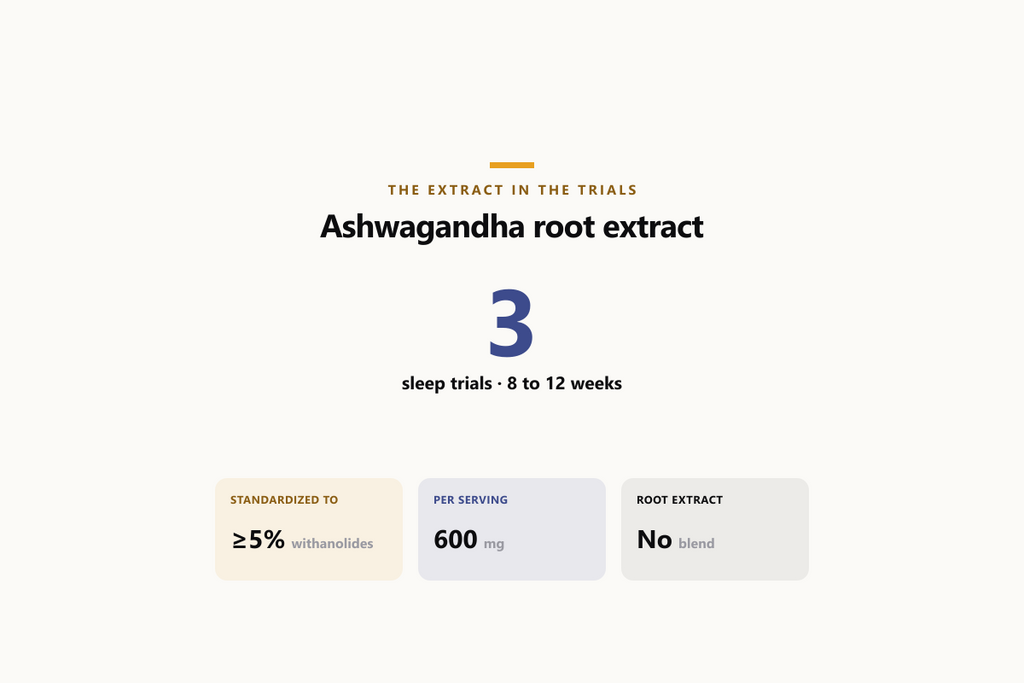
Three KSM‑66 trials, in numbers
Each trial below used 600 mg of KSM‑66 a day, the same daily amount as one two-capsule serving of Small Hours. None of these trials tested Small Hours itself.
Stress, 60 days. Chandrasekhar 2012 (PMID 23439798)
64 adults with a history of chronic stress took KSM‑66 or placebo for 60 days. Scores on all the stress-assessment scales dropped more than with placebo (p < 0.0001), and so did serum cortisol (p = 0.0006). It was a stress trial, not a sleep trial.
Sleep, 10 weeks. Langade 2019 (PMID 31728244)
60 participants (40 on KSM‑66, 20 on placebo) for 10 weeks. Sleep was tracked with a wrist actigraphy watch and questionnaires at weeks 5 and 10. Everyone in it had a clinical sleep complaint, so we don't claim its results for Small Hours.
Sleep in older adults, 12 weeks. Kelgane 2020 (PMID 32226684)
50 healthy adults aged 65 to 80 (25 per group) for 12 weeks. Sleep quality, rated each morning on waking, improved more than with placebo (p < 0.0001), and so did alertness on rising (p < 0.05). 11 of the 50 dropped out. The KSM‑66 was supplied by its maker, Ixoreal Biomed.
What these trials don't tell you. They're small, most of what they measured comes from questionnaires, and they tested one ingredient on its own, not a three-ingredient formula. Who took part matters as much as the result, which is why it's listed above.
Why the dose matters as much as the extract
Even with the right extract, an underdosed product can't be compared with the studies. A lot of "proprietary blends" bury ashwagandha in a mix of five or six ingredients at a combined weight that leaves each one at a fraction of the dose used in actual research.
Small Hours uses 600 mg of ashwagandha root extract per serving — the daily amount used in the published trials we cite, not a fraction of a blend.
What to look for on a label
- The specific extract name (for example KSM‑66 or Sensoril) — not just "ashwagandha"
- The standardization percentage (we use 5% withanolides)
- The actual milligram dose per serving — not buried inside a "proprietary blend" total
- Whether it's a root extract or a leaf/root mix — root-only tends to align with most published research
The short version: the plant name on the label is the least useful piece of information. The extract, the standardization, and the dose are what actually tell you whether you're getting something studied.
