
In this series we’ve found doses given only inside blends, inflated on front labels, diluted inside formulas, and matched to other extracts’ trials on labels that don’t name the extract. This is the fifth pattern, and it’s the strangest one: a dose with no trial of apigenin alone behind it.
Apigenin is a flavonoid found in chamomile. The NIH label database mentions it 3,029 times — almost always as a standardization marker inside chamomile extracts. But 84 products list apigenin as an ingredient in its own right, and because that’s a countable number, we counted every one. A census of a newborn niche.
The wave has a date on it
The database records when each label entered it. For apigenin, the timeline is blunt:
- Through 2021: a trickle — 33 products in a decade, mostly chamomile-based lines listing their apigenin content. Median apigenin per serving: 5 mg.
- 2022 onward: 51 products — 61% of everything that exists. Twenty-three arrived in 2025 alone. Median: 35 mg, with a hard cluster at exactly 50.
No clinical trial of apigenin alone accounts for the change. Among dedicated apigenin bottles with a stated dose, eight of nine sell exactly 50 mg. Six products now combine apigenin, theanine and magnesium in one capsule. One product sells 500 mg — ten times that number.
The apigenin census · all 84 products · NIH database
When apigenin products entered the database
Every product listing apigenin as its own ingredient, by year of entry.
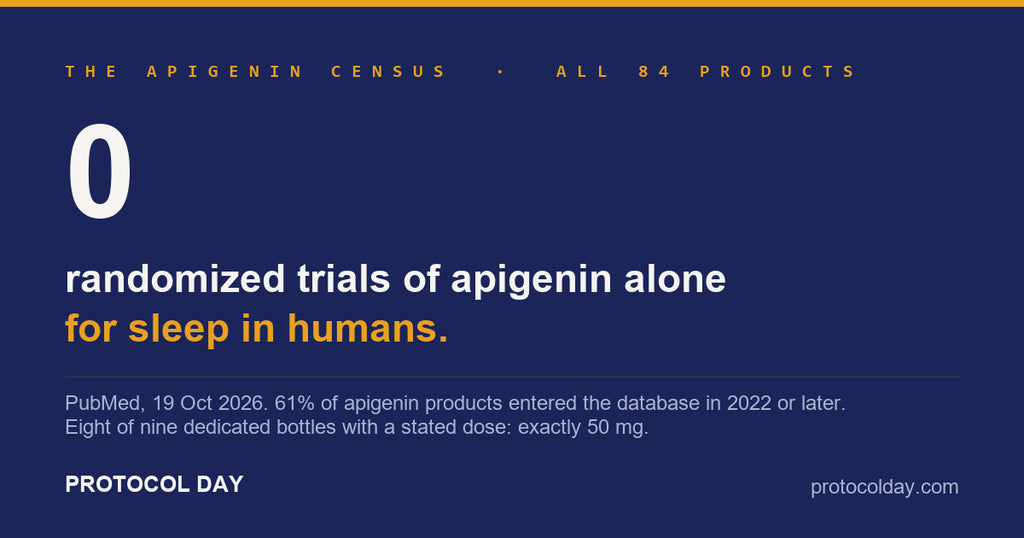
Before the line: median 5 mg, mostly chamomile-based lines. After: a hard cluster at 50 mg — eight of nine dedicated bottles sell exactly that. PubMed trials of isolated apigenin for sleep, at any dose: zero.
What the evidence says: we looked, and there isn’t any
We searched PubMed on 30 August 2026, and we’ll show our queries so you can repeat them:
- “apigenin AND sleep AND randomized controlled trial” — zero results.
- “apigenin AND insomnia AND humans” — six results: a mouse study, a fruit-fly screen, two network-pharmacology papers on herbal decoctions, a chemistry paper about passionflower, and a general review. We found no randomized trial of apigenin alone for sleep, at any dose.
The human evidence that does exist is for chamomile — the whole extract. A randomized pilot in chronic insomnia used 270 mg of chamomile extract twice daily (PMID 21939549). Here’s the part worth sitting with: the pre-2022 chamomile-based products in our census deliver a median of 5 mg of apigenin. The new pills sell ten times that — a dose that appears in no study of the whole herb, and in no randomized trial of apigenin alone for sleep that we found.
So we found no trial of apigenin alone behind the 50 mg number on those labels.
Small Hours · melatonin‑free · not on sale yet — get the free Playbook + 10% off ↓Small Hours · melatonin‑free — see what's in it ↓To be fair to apigenin
Untested is not disproven. There’s animal work — and a plausible mechanism story. Apigenin at 50 mg might work; no trial has tested it alone. Our objection isn’t to the molecule. It’s that many products standardized on a dose that no randomized trial of apigenin alone for sleep has tested — and the labels don’t say so. A buyer comparing a 50 mg apigenin bottle to a 600 mg ashwagandha bottle sees two numbers. Only one has trials of that ingredient on its own, at that dose.
Where we stand
Full disclosure, sharper than usual: apigenin is on our published list of rejected ingredients — we considered it and said no, for exactly the reason above, before we ran this count. Our own sleep formula, Small Hours, leaves apigenin out; weigh this accordingly. The data is public so you don’t have to trust us.
Limits: the census covers the NIH database, which is voluntary — marketplace-only brands are underrepresented, and this niche lives on marketplaces, so the real wave is likely larger than our count. Entry dates record when a label was added to the database, which can lag the product’s launch. And absence of trials was checked by the searches above — if a registered trial published after our search date, we’d genuinely like to hear about it.
How to read an apigenin label in ten seconds
- Ask what the 50 is. No trial has tested apigenin alone at 50 mg. One randomized trial used 50 mg inside a combination with magnesium and L-theanine (PMID 42829807), so it can’t show what apigenin did on its own.
- Chamomile is the studied form. If you want the evidence-backed version of this flavonoid, it comes as 270 mg of chamomile extract twice a day — carrying a few milligrams of apigenin, not fifty.
- Check each ingredient on its own. Magnesium and theanine have trials. Bundling them with a third ingredient that has no trial of its own doesn’t extend their evidence to it.
How we counted, so you can check us
We pulled all 3,029 “apigenin” matches from the DSLD on 30 August 2026 and kept the 84 on-market products listing apigenin as an ingredient line (not merely a standardization note); all 84 labels were pulled in full. Doses are per serving; 11 products give the dose only inside a blend. Era analysis uses the database’s label entry dates. PubMed queries are quoted verbatim above with their result counts as of the same date.
How the records were handled: scripts pulled the label records from the DSLD and extracted the lines counted here; any records we checked by hand are described in this section. Counts are per label record and are not weighted by sales: a best-seller and a small brand count the same. The dataset behind this count is available on request at hello@protocolday.com.
The database is free and needs no account. If you repeat this and get different numbers, we’d like to know.
This article is educational and is not medical advice; if you have a medical condition or take medication, talk to your healthcare provider.
GABA is the older cousin of this phenomenon: two dosing camps an order of magnitude apart, one descending from manufacturer-run studies, the other from the older sports-nutrition convention.
